
New Publication: Primary Care Trainees Learn about Aging in Place via an Academic-Area Agency on Aging Partnership
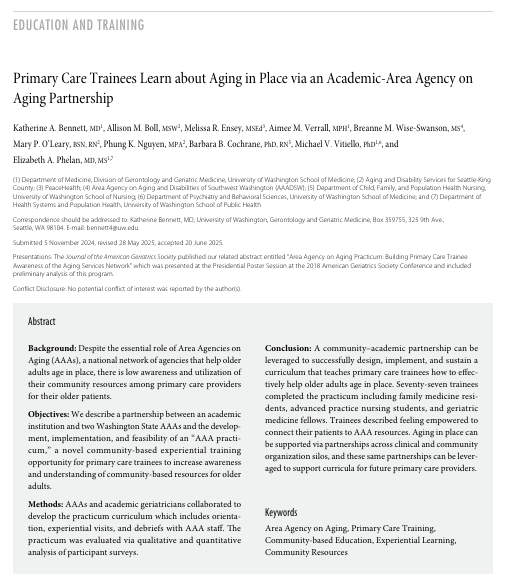
As the U.S. population ages, helping older adults remain healthy, independent, and connected in their communities has become an urgent priority. While Area Agencies on Aging (AAAs) play a critical role in supporting aging in place, many primary care clinicians are unfamiliar with the full range of services these agencies provide. A recently published study describes an innovative solution: an experiential AAA Practicum that brings primary care trainees directly into the community to learn how aging services work in practice.
The study, led by researchers at the University of Washington in partnership with two Washington State AAAs, examined the development and impact of a hands-on training experience for future primary care providers. The practicum was designed through the Northwest Geriatrics Workforce Enhancement Center, part of a national initiative funded by the Health Resources and Services Administration to strengthen the geriatrics workforce.
The goal was simple but powerful: increase trainees’ awareness of aging services and build their confidence in connecting older adults and caregivers to community-based resources that support aging in place.
Between 2016 and 2020, 77 primary care trainees completed the practicum. Participants represented multiple disciplines and training settings, from urban academic medical centers to rural and community-based residency programs. This diversity allowed the program to be tested across different clinical contexts and learner needs.
The results were striking. Nearly all participants reported high satisfaction with the practicum, and 96% said it would change how they care for older patients. Trainees described feeling more confident, better informed, and more prepared to refer patients and caregivers to aging services. Qualitative feedback reinforced these findings. Trainees emphasized how seeing services “on the ground” made community resources tangible and meaningful. Many noted a new appreciation for the challenges faced by caregivers and the importance of addressing social determinants of health alongside medical care. The practicum did not only benefit trainees. AAA staff reported improved communication with clinicians, increased referrals, and greater recognition of their work. Staff also described feeling less siloed and more connected to the health care system—an important step toward integrated, person-centered care.
This study highlights how academic–community partnerships can strengthen the future health care workforce while improving connections between clinical care and community resources. Even brief, well-designed experiences can have a lasting impact when baseline awareness is low.