
Late-Breaking at GSA: Advancing Rural and Age-Friendly Education
NW GWEC was honored to have two late-breaking abstracts accepted as poster presentations at the Gerontological Society of America’s (GSA) Annual Scientific Conference in Boston, MA:
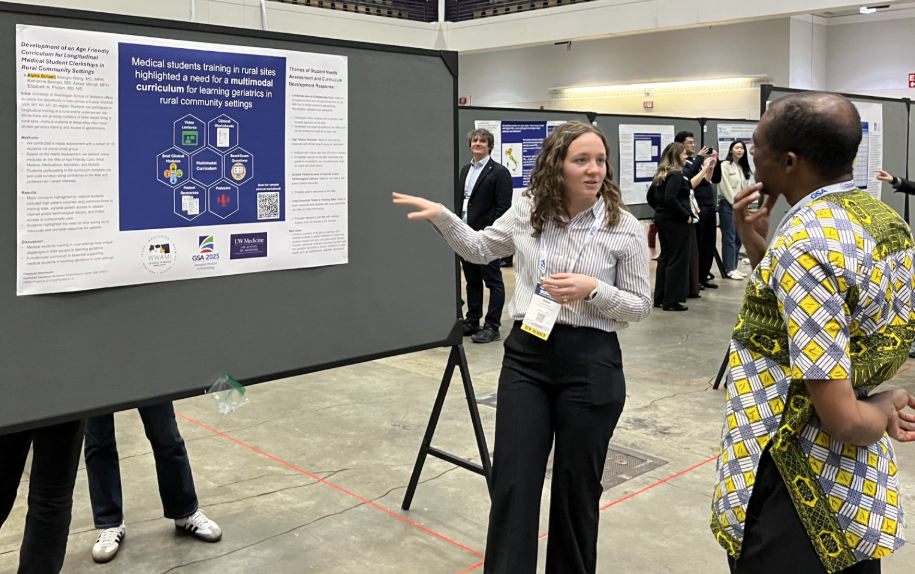
- Development of an Age-Friendly Curriculum for Longitudinal Medical Student Clerkships in Rural Community Settings, presented by Alpha Scheel, MD
-
Assessing Readiness and Advancing Age-Friendly Health Systems in Rural Washington State, presented by Anita Souza, PhD
University of Washington medical student, Alpha Scheel, MD, presented on our new Age-Friendly geriatrics curriculum to better prepare medical students training in rural and underserved communities through the TRUST and WRITE programs. A needs assessment with students revealed gaps in geriatrics training and highlighted the need for practical tools, printable patient resources, and audio learning materials. In response, the team developed a four-part curriculum organized around the 4Ms of Age-Friendly Care—Mentation, Mobility, Medications, and What Matters—using videos, podcasts, clinical guides, and practice questions. The first refined version of the curriculum was rolled out to 18 students in August 2025, with evaluation underway to assess changes in competence and interest in caring for older adults in rural settings.
Assessing Readiness and Advancing Age-Friendly Health Systems in Rural Washington State was presented as a late-breaking poster at GSA 2025 by Anita Souza, PhD, Clinical Professor of University of Washington School of Nursing. Their project supported three rural health systems in Washington State as they assessed their current practices, implemented education and evaluation activities, and aligned care processes with the 4Ms framework to pursue Institute for Healthcare Improvement (IHI) Age-Friendly Health System recognition. With targeted assistance from an Age-Friendly Outreach Coordinator, all participating sites—including five primary care clinics, a critical access hospital, and a nursing home—successfully achieved Level 1 recognition. This work highlights the readiness, adaptability, and commitment of rural providers to advancing age-friendly, person-centered care, with next steps focused on sustaining changes, expanding evaluation, and continuing support for rural organizations.